
Working Equitation Florida™
What Dressage Really Is
Dressage is simply systematic gymnastic training that makes a horse more rideable, balanced, and responsive, so it can do its job with less effort and more longevity. Classical dressage developed as a way to prepare war and working horses to be agile, adjustable, and safe under pressure, not as a stand‑alone show sport.
In working equitation and cattle work, dressage is the “flatwork foundation” that lets a horse turn quickly, stop and go instantly, and stay mentally focused without getting tense. When riders understand dressage as functional training instead of “fancy prancing,” the connection to real work becomes obvious.
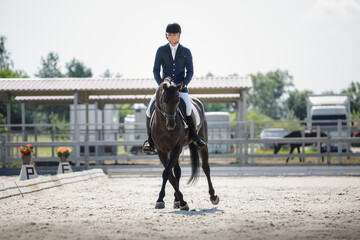
Dressage is: physical conditioning + communication training.
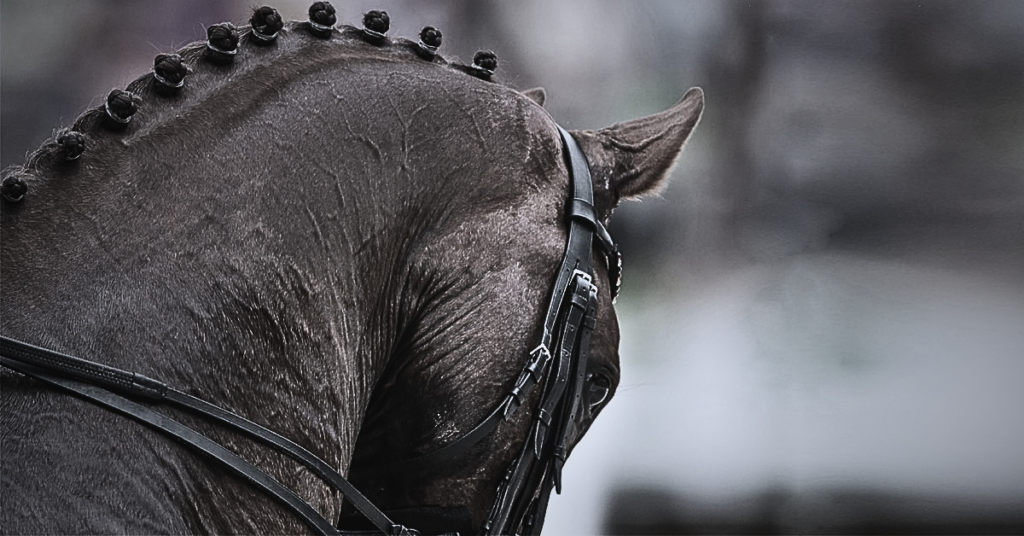
Dressage is not: only for warmbloods, only for competition riders, or about forcing a “frame.”
Why Dressage Matters for Working Equitation
Good dressage training improves a working equitation horse in very concrete ways:
-
Better balance
School figures like circles, serpentines, and transitions teach the horse to carry more weight behind instead of on the forehand. This improves sure‑footedness and stopping power. -
More agility
Lateral work and frequent changes of bend make it easier to turn around a pole, respond to the garrocha, or change direction after cattle without losing rhythm. -
Clear communication
By practicing precision in the arena, the rider learns to use smaller, clearer aids. That same quiet communication keeps the horse calmer and more confident on the obstacles or with cattle.
The Training Scale in Plain English
A Note on Older Versions of the Training Scale
You may see older or alternative versions of the training scale that show Rhythm and Relaxation together at the base. That idea is still very useful: a horse cannot truly relax and become supple if the rhythm is irregular or the tempo is all over the place.
For our purposes in working equitation, think of it this way:
-
First, you establish a clear rhythm and a steady, appropriate tempo in each gait.
-
That steadiness is what allows the horse’s body and mind to let go of tension and relax.
-
Out of that real relaxation, you begin to feel true suppleness: the back swings, the neck softens, and the horse can bend without stiffness.
Whenever you lose that relaxation or suppleness—maybe the horse tightens at a new obstacle or gets quick with cattle—you don’t “push on” up the scale. You go back down, re‑establish the rhythm and tempo, and wait for relaxation to return. Those little cycles of stepping up and then revisiting the base are not mistakes; they are the essence of training progress.
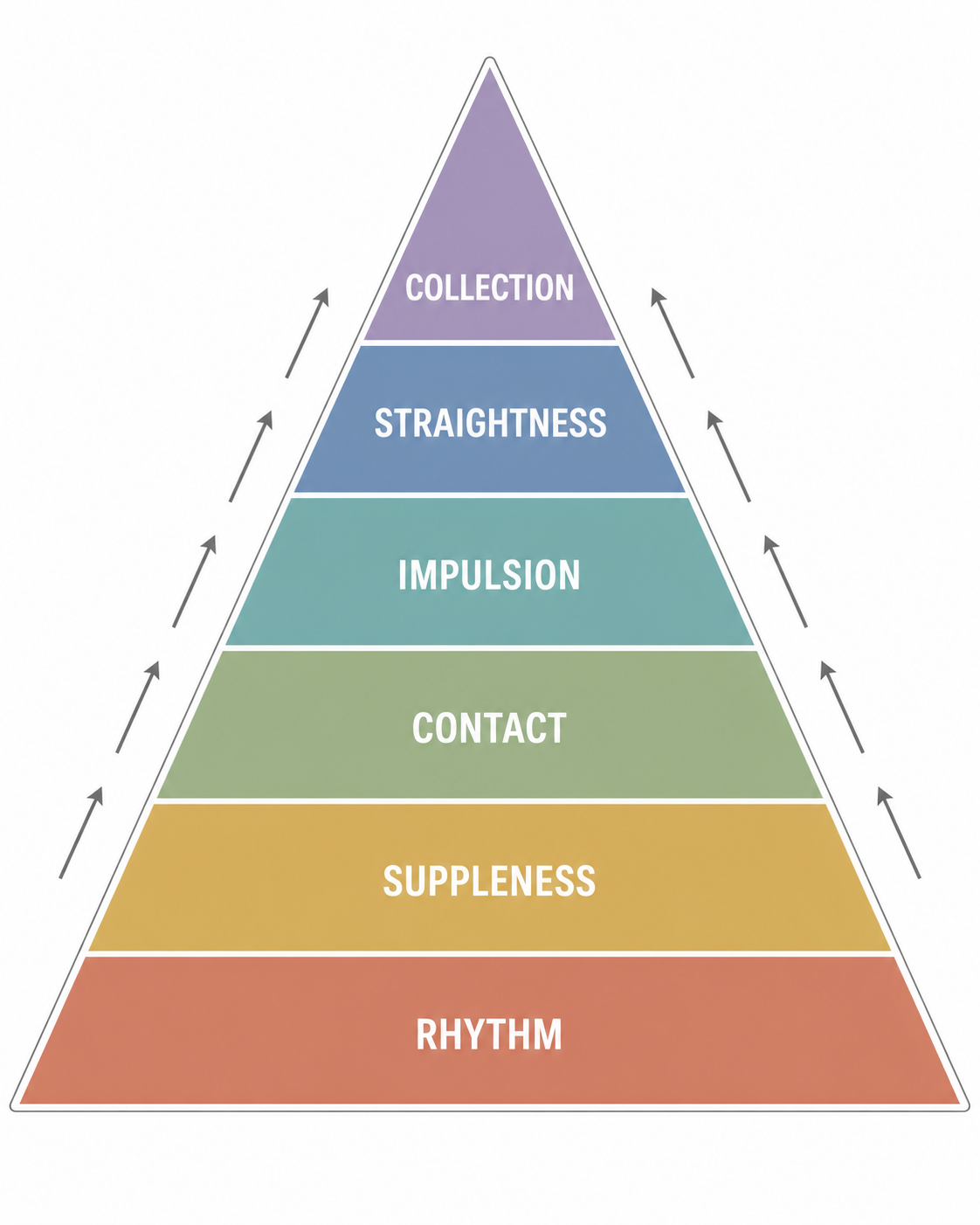
1. Rhythm
Rhythm is the clear, repeating pattern of footfalls in each gait: four beats in walk, two beats in trot, three beats in canter. It tells you which feet are hitting the ground and in what order, and that pattern should stay pure and regular.
Riders often confuse rhythm with tempo.
Rhythm = the pattern of the beats (4‑beat walk, 2‑beat trot, 3‑beat canter).
Tempo = how fast those beats repeat, like a metronome set slower or faster.
A horse can have a correct rhythm at different tempos: a slower trot or a quicker trot are both still a 2‑beat trot, as long as the diagonal pairs stay even. Loss of rhythm feels like the gait itself has broken down—irregular steps, extra beats, or “funny” strides—rather than just getting a bit faster or slower.
In WE: rhythm keeps circles, serpentines, and approaches to obstacles smooth instead of rushed or choppy.
2. Relaxation / Suppleness
The horse’s muscles swing and soften; it breathes calmly, without bracing against the rider.
In WE: a supple horse can bend around barrels or poles without losing balance or getting tight in the back.
3. Contact
The horse confidently reaches into a light, steady rein connection, without curling behind or leaning.
In WE: consistent contact makes transitions and changes of direction clearer, especially when the rider is also handling a garrocha.
4. Impulsion
The hind legs push actively under the body, giving energy and “spring” without rushing.
In WE: impulsion gives the horse the power to lengthen, shorten, and turn quickly when approaching or leaving obstacles, or when separating cattle.
5. Straightness
The horse’s body follows the line it is traveling on, instead of falling in or drifting out.
In WE: straightness is crucial for precise lines to and from obstacles, and for clean, efficient cattle work.
6. Collection
The horse sits more behind and carries more of its weight on the hindquarters, making the front lighter and more maneuverable.
In WE: collection allows quick stops, pirouette‑type turns around the hindquarters, and efficient, on‑the‑spot responses in tight situations.
Understanding the Dressage Court
Let’s talk about the dressage court as if we’re standing in it together.
The 20 x 40 arena: your training grid
Picture a rectangle that is 20 meters wide and 40 meters long.
You are standing at one of the short ends. That entry end is called A. The far short end is C. Along the long sides are the other letters: K, E, H on one side, and F, B, M on the other.
These letters are not decoration. They are your landmarks. When you hear “trot at A,” “circle at E,” or “halt at X,” the letters tell you exactly where to do each movement so you can ride with precision instead of guesswork.
In lessons and in working equitation dressage tests, we use these points to teach you and your horse to be accurate:
-
Start the transition at the letter.
-
Ride a circle that really starts and ends at the letter.
-
Change direction between two letters, not somewhere “over there in the middle.”
Over time, your horse starts to feel these patterns and anticipate the balance changes that go with them.
Why these strange letters? (And not A B C D E F G…)
You might be wondering why the arena isn’t just labeled A, B, C, D all the way around. The short answer is: no one knows for sure, but there are some strong historical clues.
The most commonly shared story takes us back to the old Imperial German Court. In the Royal stables, there was a large yard used to exercise and present horses. The walls of this yard were marked with letters, each one linked to a particular rank or person at court. The groom would stand at the letter that matched the title of the rider who owned that horse. Over time, when those same yards were used for schooling and later for early dressage competitions, the letters stayed as convenient markers.
Modern dressage borrowed that system. So instead of using A–B–C–D around the edge, we inherited this older, more “mysterious” sequence: A, K, E, H, C, M, B, F. It feels random, but it comes from a very practical need: “Where is my horse supposed to be?” The answer was “at your letter.”
For you, as a working equitation rider, the exact history is less important than this:
-
The letters are fixed reference points the same way all over the world.
-
They allow us to ride and judge movements down to the meter, which is what builds real accuracy.
Walking the letters together
Imagine we’re in the 20 x 40 arena now.
-
We enter at A and ride straight down the long side.
-
The first letter we pass on the right is K.
-
When we reach the middle of that long side, we are at E.
-
Closer to the far corner is H.
-
Directly opposite A on the far short side is C.
-
Coming back down the other long side, we pass M (near C), B (middle of that long side), and F (near A).
Now think of a line running right up the middle from A to C. That is the center line. The exact middle of the arena, where those two lines cross, is X. You will halt there a lot.
Here’s how you start to use this in your riding:
-
“Trot at A” – you prepare before A, but the new gait actually starts at the letter.
-
“Circle 20 meters at E” – your circle touches the track near E and C, and the imaginary quarter points, not somewhere vague and egg‑shaped.
-
“Halt at X” – you don’t wander to the middle and hope you’re close; you ride a straight line from A, keeping the shoulders between the rails, and stop at the invisible cross that is X.
Why this matters for working equitation
You might be thinking, “I just want to ride obstacles and work cattle—why should I care about letters?”
Because the same skills that let you hit your marks in the dressage court are what keep you accurate and efficient later:
-
If you can ride a straight line from A to X to C, you can ride a clean, straight approach to a jump, the bell corridor, or the pen.
-
If you can ride a round 20 m circle at C, you can bend around a barrel or pole without your horse falling in or drifting out.
-
If you can consistently make transitions at a letter, you can consistently prepare your horse to go from one obstacle to the next, or adjust speed cleanly when you separate a cow.
So when you see those white rails and strange letters, don’t think “fussy dressage people.”
Think: this is my training grid. This is the place where I teach my horse to be so balanced, precise, and responsive that later, out on the obstacles or with cattle, everything feels easy.