WEFL Foundations Mentorship — Program Syllabus
2026 Premier Class
What this program is
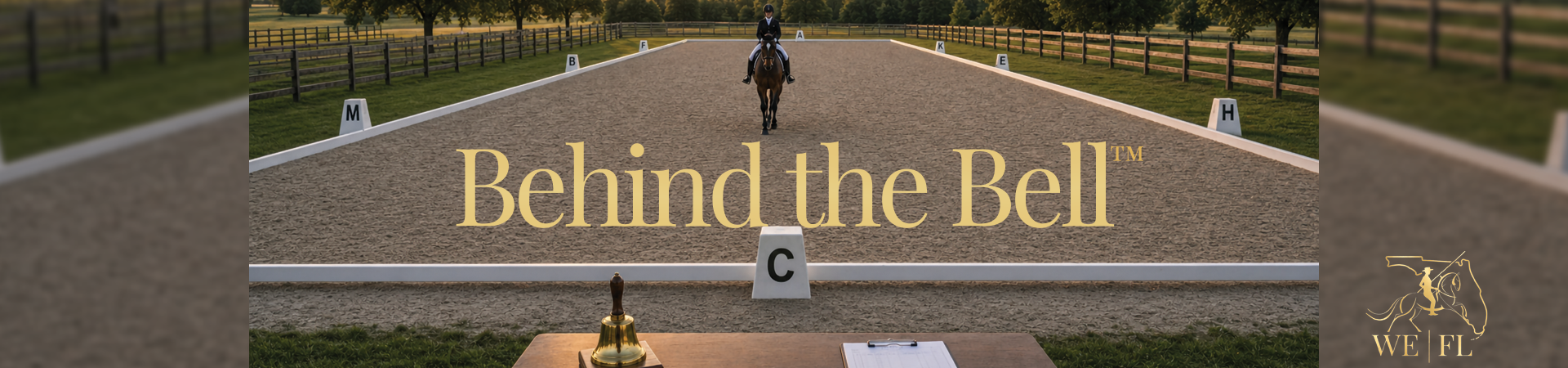
Behind the Bell™ is a twelve-module mentorship for people who want to understand working equitation from the inside — from the judge’s chair, the technical delegate’s clipboard, the scribe’s seat, and the show office.
It is built for riders who have started asking why a score came out the way it did, for volunteers who want to be genuinely useful at a show instead of just present, and for anyone considering a future as an official but who doesn’t yet know what that path actually requires.
Two kinds of people belong here, equally
About half the people who come to a program like this are thinking about licensure someday. The other half have no intention of ever officiating — they want to ride better, volunteer well, run a show office competently, or simply stop feeling lost when the scores come out.
Both are the point. Neither is the lesser version.
If licensure is your goal, this program gives you the fluency to walk into that process already knowing the language. If it is not, you get the same understanding for its own sake, and the sport gets a more capable participant. We build for both from Module 1 forward.
What this program is not
This is not a licensing or certification program, and it is education rather than training. USA Working Equitation is the licensing body for officials in this country. Nothing in Behind the Bell™ confers a license, a certification, or any official status.
The distinction we hold ourselves to: we teach the roles anyone can hold, and we study the roles USAWE licenses. Scribing, scoring, gate stewarding, and paddock work are skills we teach outright, because nobody licenses them and every show needs people who can do them well. Judging and technical delegating are functions we study and understand — how a judge scores, why a TD makes the call they make — because those carry authority that only USAWE can grant.
What this program does is prepare you — so that when you sit down to scribe, volunteer as gate steward, or eventually pursue USAWE licensing, you arrive already fluent in the language, the rulebook, and the expectations.
Think of it as the education that should come before the application.
How the program is delivered
Twelve modules, released one per month, in order.
Each module contains a set of written lessons, practical exercises you complete on your own, and a live online session with discussion and Q&A.
Please read this before you enroll
The full program is not finished at launch. Module 1 opens on August 1, 2026. The remaining modules are written and released on a rolling basis.
Our committed pace is one new module per month, in numerical order. That is the promise, and it is the pace we will hold ourselves to.
We fully expect to publish faster than that. As modules are completed they go live immediately, and we anticipate the full twelve being available well before month twelve. We are deliberately not promising a date for that — we would rather beat a modest commitment than miss an ambitious one.
You control your own pace
Once a module is published, it is open to you for as long as your membership is active. There is no gate, no sequence lock, and no waiting for the class to catch up.
- Move faster if you want. If four modules are live and you want to finish all four in a weekend, nothing stops you.
- Skip around. If Ease of Handling is what you came for and it’s published, go there first. The modules are built to reinforce each other, but they don’t require lockstep order.
- Move slower if life happens. Falling behind the cohort costs you nothing. Published modules stay open to you, and every live session is recorded.
- Live sessions follow the monthly cadence and are recorded, so missing one costs you nothing but the chance to ask your question in real time.
The monthly rhythm exists to keep the cohort moving together and to give the live sessions a shared focus. It is a floor, not a ceiling.
Membership and billing
Behind the Bell™ is a monthly subscription. Your membership gives you access to every module published so far, the live sessions, and the recordings — not one module per payment.
That distinction matters. In a month where no new module is released, your membership still includes the full library to that point, a live session, and the discussion around it.
You can cancel at any time from your account page. Your access continues through the end of the period you have already paid for, and nothing is charged after that. There is no contract and no minimum term.
If you need to step away temporarily for a real reason, contact us before you cancel — we would rather work something out than lose you.
The twelve modules
Module 1 — How a Working Equitation Show Actually Runs
Available August 1, 2026
The orientation module, and the one that gives you the vocabulary for everything after it.
- What Behind the Bell™ is, and honestly what it is not
- The anatomy of a working equitation competition: the four trials, the levels, and how scores combine into a placing
- The arena itself — geometry, letters, and why the layout is what it is
- The show-day cast: manager, secretary, judge, technical delegate, scribe, scorer, gate steward, paddock, announcer, and who owns which decision
- The rulebook as a working tool — how it is organized and how to find an answer fast
- Conduct, ethics, and confidentiality in officiating spaces
- The pathways: judge, technical delegate, show staff, and how USAWE licensing actually works
- Finding your own starting point
A note on language: this module draws a hard line between USAWE licensed shows and WEFL Recognized schooling shows. These are not interchangeable terms, and people use them incorrectly constantly. Getting this right is one of the first things that marks you as someone who has done the work.
Module 2 — The Rulebook as a Working Tool
Moving from knowing the rulebook exists to using it under pressure.
- How the sections relate and where cross-references lead
- The definitions that everything else depends on
- High-priority sections for each trial and for show procedure
- Finding an answer while a rider is standing in front of you waiting
Module 3 — Dressage Judging Fundamentals I
What the judge is actually looking at.
- The purpose of the Dressage trial within working equitation
- Scoring basics, and what a judge notices in the first ten seconds
- Accuracy, balance, the basics, and rider effectiveness
- How individual movement marks relate to the overall impression
Module 4 — Dressage Judging Fundamentals II
Depth on movements, figures, and collective marks.
- Common movements and the quality indicators inside each
- What pushes a mark up, and what pulls it down
- What makes a judge’s written comment concise, useful, and defensible
- Studying two rides side by side and understanding why they scored differently
Module 5 — Dressage Tests, Scribing, and Score Sheets
The mechanics, and the job most of you will do first.
- Reading and following a test
- What separates a good scribe from a merely adequate one
- Pace, legibility, abbreviations, and professionalism in the box
- How a score sheet travels from the judge’s hand to the final placing
Module 6 — Dressage in Practice
Consistency, calibration, and the honest difficulty of scoring.
- Following full tests start to finish
- Where reasonable judges disagree, and where they shouldn’t
- How judges calibrate, and why consistency is genuinely hard to hold
- How officials keep notes that survive a long day
Module 7 — Ease of Handling Fundamentals
The trial that makes working equitation what it is.
- What EOH is designed to test, and why it exists
- How Dressage principles carry directly into obstacle work — balance, rhythm, straightness, responsiveness, presentation
- Quality and effectiveness versus mere completion
- Rider strategy, obedience, and accuracy
- The difference between educated observation and formal judging authority
Module 8 — Obstacles in Detail
Obstacle by obstacle, what each one is actually asking.
- The scoring logic behind every obstacle in the rulebook
- What each obstacle is designed to reveal about the horse and rider
- Common rider errors and where they originate
- How officials describe what they see at an obstacle in scoring language
Module 9 — Penalties, Eliminations, and Consistency
The part everyone argues about.
- The penalty structure and how it is applied
- Eliminations — what triggers them and exactly where to verify each one
- Fairness and consistency across a long class
- The note-taking discipline the job demands when a ride is moving fast
Module 10 — Speed and Cattle
One combined overview module covering both remaining trials at the level an official needs.
- Why Speed is a distinct trial and what it genuinely tests
- Completion standards, penalties, and rider strategy
- The Cattle Trial: purpose, format, and its relationship to the other three
- Safety and fairness considerations specific to both
- How Dressage and EOH principles underpin quality across all four trials
Module 11 — Technical Delegate, Show Management, and Course Design
The behind-the-scenes work that makes fair competition possible.
- Core TD responsibilities, and how TDs think about the role
- Communication, problem-solving, and incident handling
- Show management coordination and real staffing constraints
- Course design awareness: flow, fairness, level-appropriate questions, safety, and how layout shapes what both judge and rider experience
- Who owns a given problem — TD, show manager, office, or judge
Module 12 — Professionalism, Show Experience, and Your Own Path
Turning a year of study into a concrete next step — whichever direction that step goes.
For everyone:
- Silent judging, shadow judging, and how sustained observation builds an eye
- Scribe, scorer, gate, and paddock opportunities, and how to get them
- Professional conduct, boundaries, and building a reputation that generates invitations
- Getting genuine show experience at WEFL Recognized schooling shows
If you are heading toward licensure:
- What USAWE actually requires of an “L” judge or TD applicant, in plain language
- Which activities count, where they must happen, and who must supervise them
- Building your own documentation habit now, so the record exists when you need it
If you are not:
- Becoming the volunteer every show manager asks for by name
- Reading your own score sheets with real understanding
- Contributing to your barn, your club, and your region as an informed participant
- Where to go deeper for its own sake
An important note on what counts. Observation and volunteer hours you accumulate at WEFL Recognized schooling shows are genuine experience and will make you better. They do not count toward USAWE licensing requirements. USAWE requires that qualifying activity take place at licensed competitions under specified licensed officials, with their own forms and evaluations. We will teach you exactly where that line falls so you are never surprised by it.
What you’ll do
Every module includes work you complete on your own between live sessions. These are not busywork quizzes.
- Rulebook hunts that force you to find answers yourself rather than take our word for it
- Score sheet reading and comment analysis
- Video and scenario review
- Discussion prompts that come back later in the program, so you can see how much your thinking has changed
- Practical readiness checklists for volunteering at real shows
Live sessions
One live online session per module, roughly two hours, recorded for anyone who can’t attend.
The format is discussion rather than lecture — case studies, participant questions, and where possible a guest segment with a working official.
What you’ll have at the end
Not a license. Not a certification.
A genuine working knowledge of how the sport is officiated, your own record of the work you have done, a personal plan for wherever you are headed next, and the confidence to walk into a show office and be useful.
Behind the Bell™ is an independent educational program of Working Equitation Florida. It is not affiliated with, endorsed by, or approved by USA Working Equitation. USAWE is the licensing body for officials in the United States. This program confers no license, certification, or official status, and does not satisfy or count toward USAWE licensing requirements or continuing education hours.